

Movie posters are more than just promotional tools—they are a powerful way of storytelling and give us clues about the narratives they represent.
In his article, The Four Principles of Storytelling, Mike Montalto mentions that there are four pillars of visual storytelling: authenticity, sensory, relevancy, and archetype. These pillars help connect with the audience and bring the story to life, which is important for movie posters that need to grab attention and hint at the film’s story in one image.
Through the use of color, composition, and symbolism, posters can evoke emotion, build suspense, and spark curiosity. Some posters tease us with hidden dangers and unseen mysteries, while others hint at the internal struggles of the characters.
As Andrew Losowksy states in his piece Visual Storytelling, “Like the soundtrack in a movie, the visuals create a barely perceptible emotional context to the telling of the main narrative.” By paying attention to the details in movie posters, we can build anticipation and even infer what could happen when we sit down to watch.
Black Swan

The Black Swan poster is a haunting close-up of Natalie Portman’s character, with a cracked, porcelain-like face. The cracks suggest fragility, both physically and emotionally, hinting at the psychological themes of the movie. The black-and-white color palette is symbolic of duality, reflecting the inner conflict between innocence and darkness.
This poster represents a deeper meaning. The cracks foreshadow the character’s mental breakdown, while the dark tones hint at the darker aspects of her mind. It’s a visual metaphor for how pursuing perfection can lead to self-destruction.
The Lord of the Rings – The Fellowship of the Ring
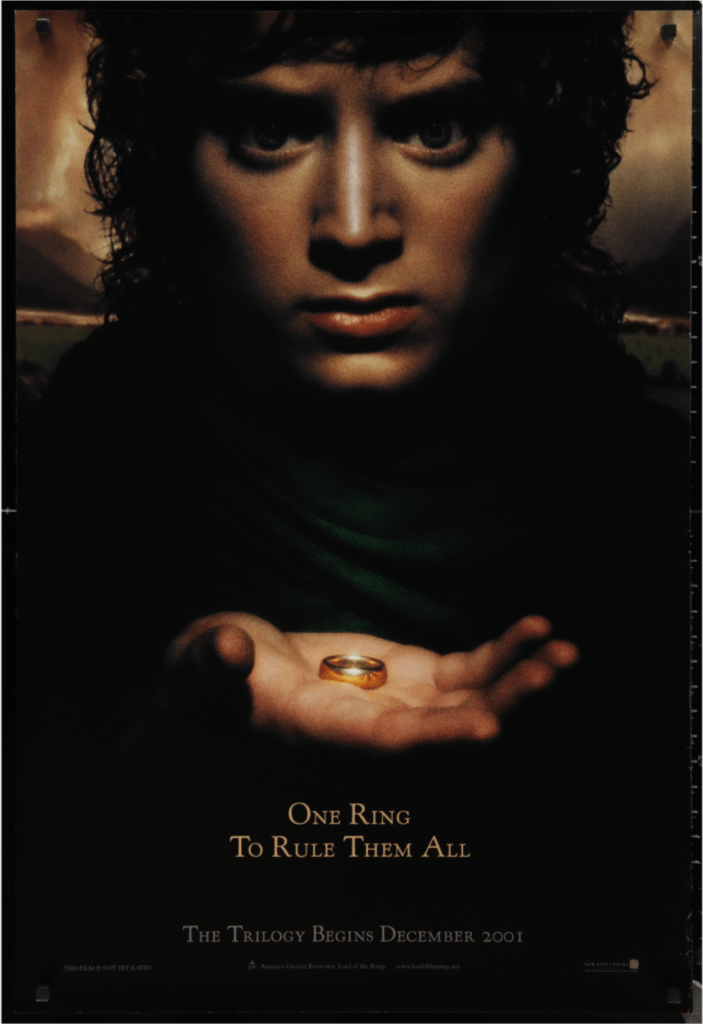
In The Lord of the Rings poster, a hooded figure (Frodo) holds a glowing ring, surrounded by a dark landscape. The ring’s centered placement and Frodo’s curious gaze suggest that the object holds power and is at the heart of the story. The background shows a world in turmoil, hinting at the larger battle between good and evil.
The use of lighting and contrast is key here, illustrating the visual design principle of focus and framing. The glowing ring draws the eye immediately, while the dark surroundings give a sense of danger and adventure. The poster hints at a story of responsibility and the struggle to resist temptation, which is central to Frodo’s journey.
Knives Out

The Knives Out poster features the ensemble cast arranged like pieces on a chessboard, with Daniel Craig’s detective character at the center. The vibrant colors and luxurious setting immediately suggest the film’s comedic yet dramatic tone.
Every detail in this poster—from the varied postures of the characters to the way they eye each other suspiciously—hints at the mystery and mind games crucial to the film’s plot. This aligns with the technique of layering information, where every visual cue, like Craig’s direct gaze or the fancy mansion, reveals something about the characters and the setting. The poster’s composition draws us in, making us wonder who is hiding what.
Joker
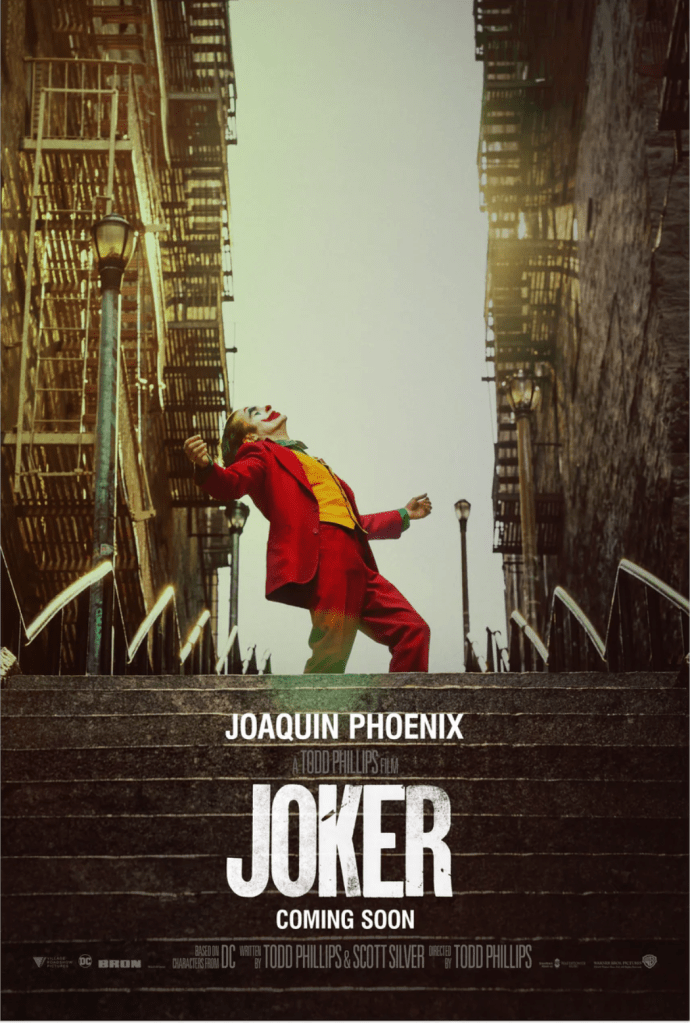
The Joker poster captures Joaquin Phoenix’s character standing in a run-down alley, dressed in full clown makeup, arms raised toward the sky. The image is vibrant yet unsettling with his character being in vivid color while the city around him is dull and grey. Contrasting colors are used to reflect the chaotic nature of the character.
The towering buildings and dark alley create a feeling of isolation and suppression, while his posture suggests rebellion and surrender at the same time. This composition mirrors the concept of contrast of emotions, where the visual tension between the character’s joyful pose and the grim setting hints at the internal struggle and unrest within society that is explored in the film. It sets the stage for the dark transformation of an ordinary man into the infamous villain.
Jaws
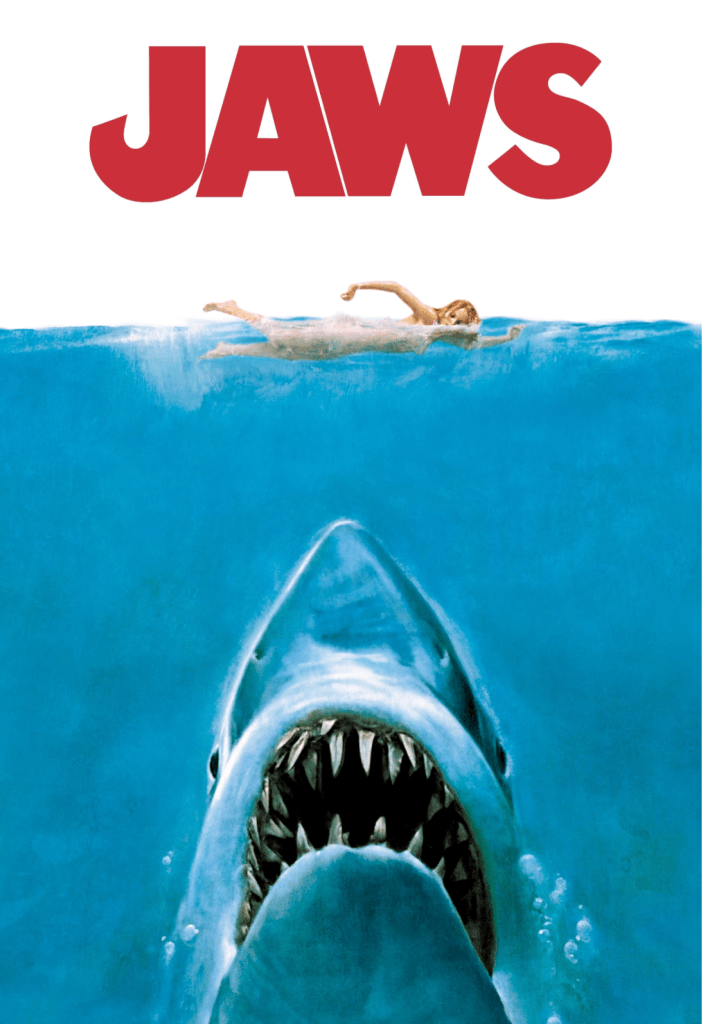
The Jaws poster is an iconic example of using simplicity and suspense in an image, showing a massive shark rising from underneath the ocean toward an unaware swimmer at the surface. The contrast between the peaceful water above and the lurking danger below creates tension, signaling the hidden threats within what seems to be a calm environment.
The shark’s menacing size and sharp teeth immediately convey danger, while the swimmer’s vulnerability of swimming mindlessly alone heightens the sense of impending doom. This poster uses anticipation and contrast to tell a story of survival and fear, hinting at the terrifying forces beneath the surface that drive the narrative of the movie.
La La Land
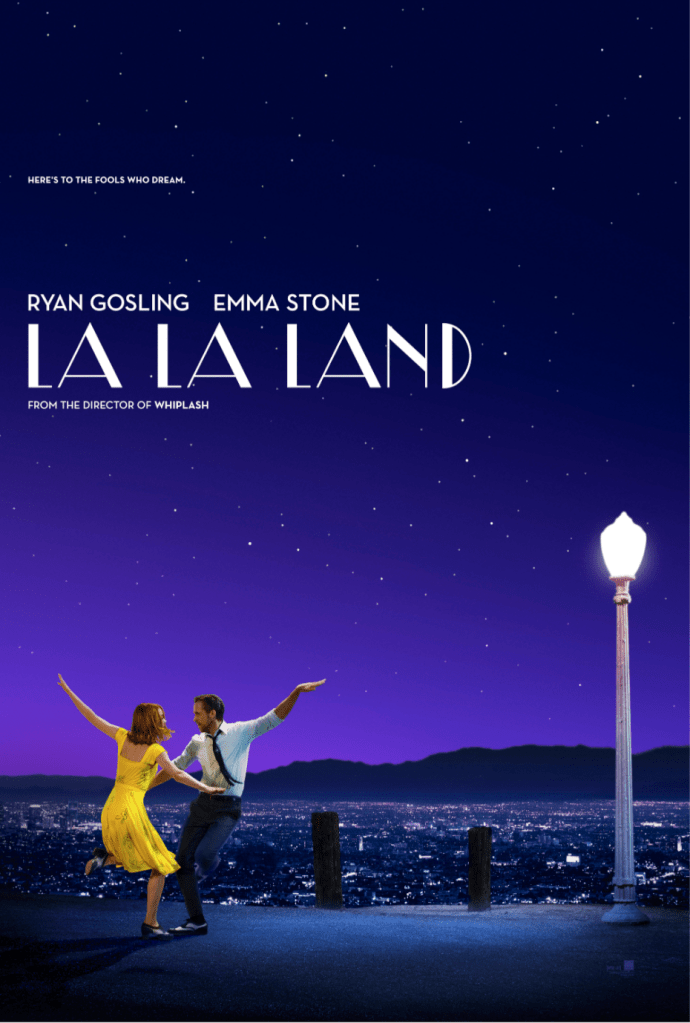
The La La Land poster features the two main characters, played by Emma Stone and Ryan Gosling, dancing gracefully under a starry sky with the Los Angeles skyline in the background. This poster hints at a story full of passion and dreams, with the city of LA playing a crucial role in their journey.
Evidently, the characters are not the center of the photo, they are off to the side and your eye is drawn to the city behind them. This is symbolic because it insinuates how their careers in LA are more important to them than their relationship. The open sky and distant city suggest both possibilities and challenges they’ll face.
You can see the principle of color psychology is used. The vibrant purples and blues create a dreamlike atmosphere that symbolize both the characters’ aspirations and the bittersweet nature of their romance.
Bird Box

In the Bird Box poster, Sandra Bullock’s character is blindfolded, holding two children who are also blindfolded close as if she is protecting them. The blindfolds are a clear visual symbol, as they represent the characters’ need to avoid seeing a mysterious danger, while the children clinging to her suggest that survival is a central theme.
This image conveys fear, protection, and vulnerability, all without showing the actual threat. The power of suggestion is used, where what’s unseen is just as important as what’s shown. The blindfold encourages the audience to imagine the danger themselves, adding suspense and intrigue to the story.
The Art Behind the Posters
These posters are more than just marketing, they’re stories that invite viewers to connect with the films before they even start watching. The details in each image—whether it’s the posture of a character, the lighting, or the use of color and symbols—tell a larger story.
As Losowsky mentions, visual storytelling: “…stirs emotions, it encourages action, it quips us, inspires us. It enriches our world in tiny ways that we may never understand.”
By paying close attention to the details, we can reveal the layers of meaning that these images hold and appreciate the artistry behind their design. Next time you go to watch a movie, check out its poster first and see if you can infer what will happen!
References
Losowsky, A. (2012). Visual Storytelling: Inspiring a new visual language. Gestalten-Verl.
Montalto, M. (2024, January 25). The four principles of visual storytelling. amplifi. https://amplifinp.com/blog/4-principles-visual-storytelling/
 Nicole Calabrese's Blog
Leave a comment