

How do you create a website that truly connects with its audience? The answer is simple: It’s all about designing with the user in mind.
Understanding User Needs
Understanding who the users are and what they need from the website is crucial. Every website has a different purpose, whether it’s selling products, providing information, or building a community.
Designers often start by creating user personas—these are profiles that represent different types of visitors to the site. These personas help guide decisions about what kind of content to include and how it should be organized.
Once the target audience is clear, it’s easier to design the website in a way that meets their needs. For example, an e-commerce website might focus on easy navigation and quick access to product details, while a nonprofit’s site might prioritize storytelling and clear donation options.
Simple Navigation
Most websites use a navigation menu that contains links to the most important sections of the site, like “Home,” “About Us,” “Services,” and “Contact.” These menus are usually consistent across all pages, so users always know where they are and can easily find what they need.
Good navigation can make or break a user’s experience. If users can’t find what they’re looking for quickly, they’ll leave the site. As Jakob Nielsen mentions in his article Is Navigation Useful?, “If a page does not appear relevant to the user’s current goals, then the user will ruthlessly click the Back button after two to three seconds.”
Some sites also include a search bar, which allows users to type in keywords and quickly find content related to their needs. This is especially helpful for content-heavy websites, like blogs or e-commerce platforms, where users might be looking for something specific.
Layout and Organization
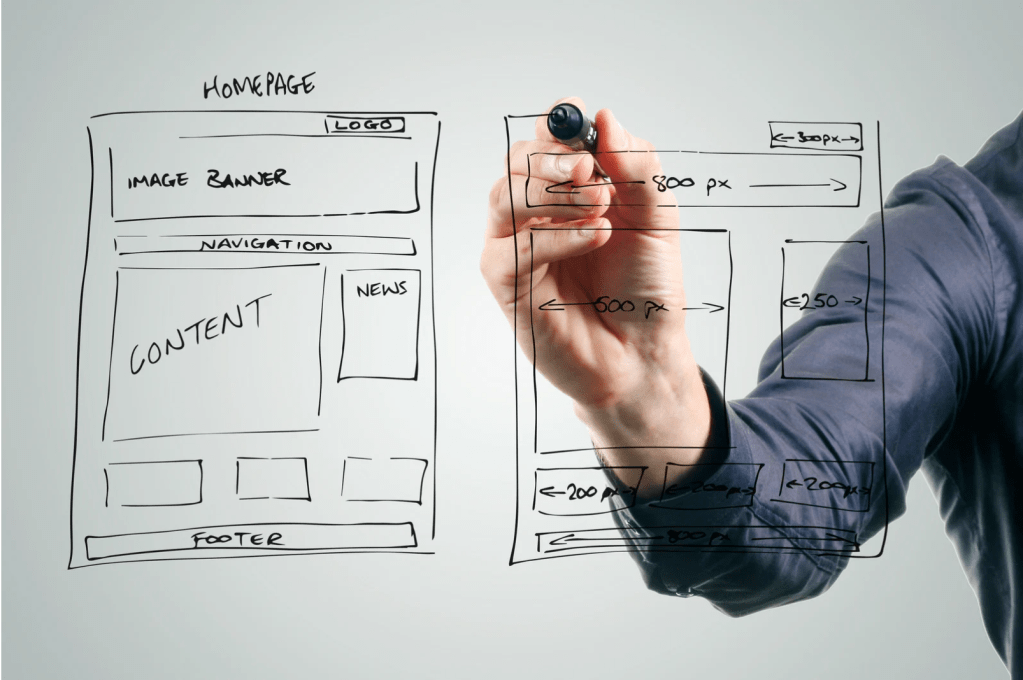
Wireframes and sitemaps are essential tools in web design that help structure content and improve user navigation.
Wireframes provide a basic visual layout of a website’s elements, showing where things like menus, buttons, text, and images will be placed. As Jeff Cardello mentions in his article The Modern Web Design Process: Creating Sitemaps and Wireframes, “Wireframes allow stakeholders to see how individual pages within a website will flow and function,”.
Sitemaps, on the other hand, organize all the website’s pages, showing how they are connected. According to Cardello, “A sitemap provides a diagram of the site’s hierarchy and shows where each page fits into this hierarchy,”.
Together, wireframes and sitemaps ensure the website is well-structured, easy to navigate, and user-friendly from the ground up.
Visual Appeal
Visual design is more than just making a website look pretty; it’s about balancing aesthetics with functionality. Designers aim for a clean, modern look with a well-chosen color palette, high-quality images, and readable fonts.
A website like Apple’s is known for its minimalist design, which uses a lot of whitespace to make the products stand out. Each page is clean and uncluttered, allowing users to focus on the iPhones, Macs, or services they’re interested in. The right balance of visuals ensures that the design doesn’t overwhelm the user but instead highlights key information.
Content that Speaks to the User
Engagement isn’t just about the design and functionality—it’s also about the content. Content should be clear, engaging, and speak directly to the visitor’s needs.
Calls to action (CTAs) are a key part of engaging content. CTAs are buttons or links that encourage users to take a specific action, like “Sign Up,” “Learn More,” or “Contact Us.” These guide users toward interacting with the website, whether it’s making a purchase, signing up for a newsletter, or reading more about a topic.
Take a website like Airbnb—their content is warm, inviting, and focuses on the experience of staying in someone’s home rather than just renting a room. Their calls to action like “Find a place to stay” are simple and compelling, guiding the user toward the next step without being pushy.
The Overall Experience
The process of creating a website today is all about making sure the user’s experience is smooth, engaging, and tailored to their needs to keep them happy and coming back for more. Whether it’s an online store, a blog, or a service platform, creating a website that puts the user first is the key to success.
View my content design example below:
References
Cardello, J. (2024, September 29). The modern web design process: Creating Sitemaps and Wireframes: Webflow blog. Webflow. https://webflow.com/blog/the-modern-web-design-process-creating-sitemaps-and-wireframes
Nielsen, J. (2018, August 20). Is navigation useful?. Nielsen Norman Group. https://www.nngroup.com/articles/is-navigation-useful/
 Nicole Calabrese's Blog
Leave a comment